The Cognitive Revolution: When AI Liberates Human Time

Just as the Industrial Revolution freed the human body from the physical burden of plowing fields, building shelters, and manual production, so too does the current revolution,…
Just as the Industrial Revolution freed the human body from the physical burden of plowing fields, building shelters, and manual production, so too does the current revolution, the Artificial Intelligence Revolution, liberate the human mind from routine and exhausting cognitive labor. What sounded like science fiction merely two years ago has already become a daily reality, in which Generative AI systems help us write, plan, summarize, write code, catalog, and research. This is only scratching the surface of their potential.
The speed with which these tools are permeating every domain of human activity is almost unfathomable. The office, the classroom, the laboratory, and even the home are all transforming into spaces where the Sisyphean tasks of thinking are performed automatically, faster, and more accurately than ever. Humanity is now invited to ask itself a profound question:
What will we do with all the time we have freed up?
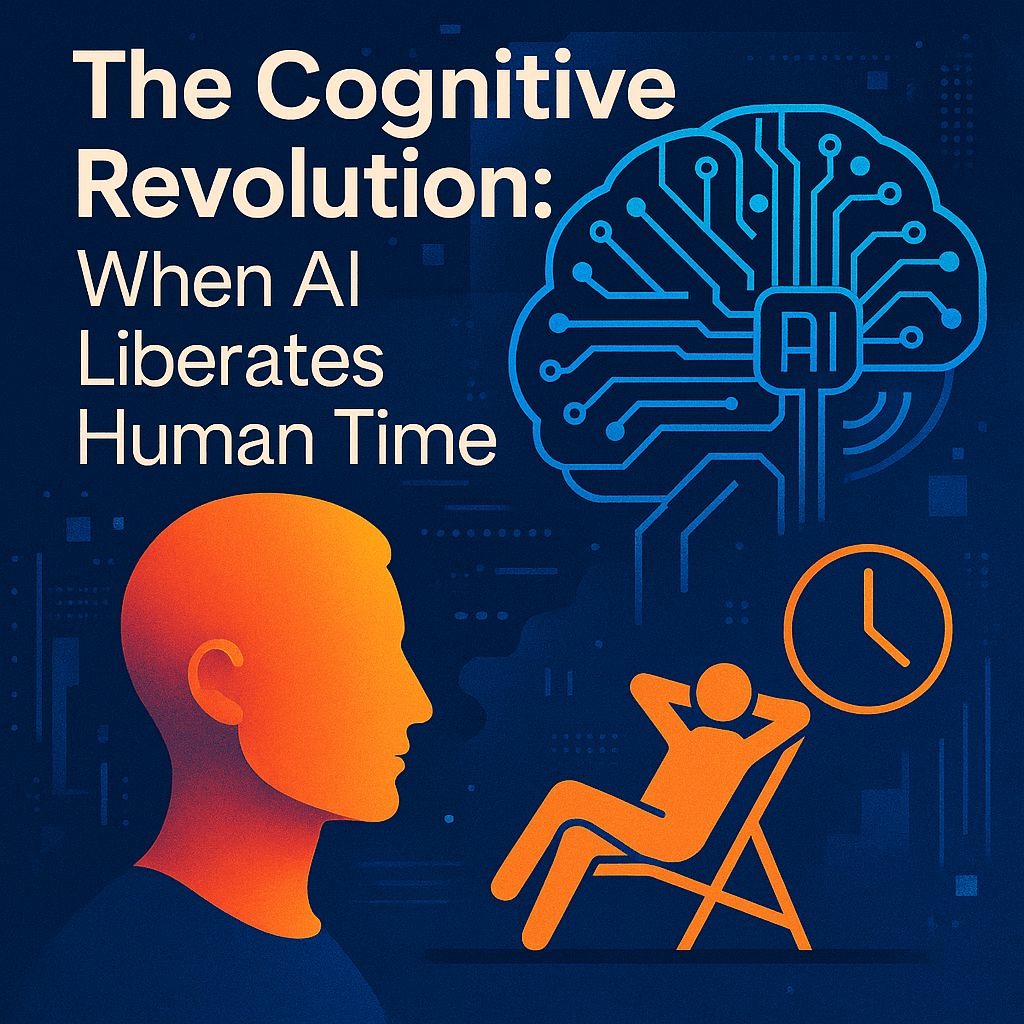
Image create by GPT-4.1
How Does the Cognitive AI Revolution Mirror the Industrial Revolution?
The cognitive AI revolution mirrors the industrial revolution by liberating human intelligence from exhausting, repetitive mental tasks. Just as steam power and mechanization replaced grueling physical labor with machines, generative AI automates drafting, code synthesis, data filtering, and administrative overhead, triggering a profound transformation in human leisure, creativity, and enterprise productivity.
In the days of the Industrial Revolution, the time saved from physical labor became a tremendous engine of progress. Cities soared to unprecedented heights, science broke through frontiers, and society reorganized itself. Humans used their newfound leisure to explore, invent, debate, and create.
That was the Leisure Revolution 1.0.
Today, we are advancing to the next stage in the evolution of action and creation: not only the physical liberation of the body, but the liberation of cognition itself.
Think about the list of tasks already moving into autonomous automation: drafting summaries and legal documents, generating insights from complex data, writing and debugging code, simultaneous translation into dozens of languages, creating multi-modal content such as text, images, video, music, scoping and planning entire projects, and much more.
There is less writing for the sake of writing, fewer endless meetings just to gather information, and less time wasted on filtering, sorting, and interpreting.
If we look back for a moment, the printing press was a turning point when knowledge was liberated from the religious and academic elite. Today, AI tools are creating another leap forward, not just the dissemination of existing knowledge, but the immediate generation and contextualization of new knowledge tailored to every person and every need.
How Does Generative AI Democratize Specialized Domain Knowledge?
Generative AI democratizes domain knowledge by providing instant, contextualized expertise without institutional gatekeeping. Rather than requiring years of credentialed study to parse complex legal, medical, or technical documents, any individual can query an AI system to synthesize actionable explanations, breaking historical barriers of socioeconomic and educational exclusion.
Until recently, in order to earn the title of educated, you had to endure a grueling path of study, exams, and certifications. At the end of that path, you received a diploma confirming you had invested your time and effort in absorbing existing material.
Today, the simple ability to articulate a question or a prompt correctly may be the equivalent of spending hours in the national library or conducting in-depth research online.
This revolution did not emerge from nowhere. We are already accustomed to having Google in our pocket, enabling us to become instant experts. But this current wave goes much deeper. It does not merely search and retrieve facts. It generates narratives, explains concepts, produces authentic and high-quality outputs, and provides each of us with personalized guidance anytime and anywhere, virtually without limits.
On the social dimension, if we look at populations that historically were left behind, whether due to discrimination, exclusion, poverty, or simply a lack of infrastructure, the potential for change is radical. AI can translate or explain a legal contract at the click of a button. A voice-based system can break down a complex medical document into plain language for someone who cannot read. An expert system can deliver professional medical opinions to anyone, anywhere, anytime. An adaptive learning algorithm can teach a shepherd’s child in a remote village programming or mathematics.
When the barrier between knowledge and understanding disappears, the dam of education bursts open.
Why Is Universal Knowledge Access a Threat to Authoritarian Control?
Universal knowledge access threatens authoritarian control because dark regimes depend on information monopolies, censorship, and manufactured perception. When decentralized AI tools provide accessible, contextualized education in native languages, population awareness expands, eroding state disinformation and reinforcing democratic principles of critical inquiry and individual agency.
Education has always been the arch-enemy of dictatorship. Dark regimes rely on controlling perception, spreading disinformation, and instilling fear of independent scrutiny and critical thinking.
When knowledge becomes easily accessible, in simple language and a culturally relevant context, the mechanisms of control weaken.
Of course, this will not happen overnight. Those in power will not surrender easily. They will use legal, political, and technological tools to delay or control access to information. But ultimately, the immense force of accessible knowledge will breach those walls and deepen the cracks.
Education will no longer be merely a privilege of the upper class or the byproduct of living in an advanced country. It will become a universal infrastructure, almost like electricity or water.
The great ideas of the Enlightenment, freedom, human rights, pluralism, morality, and liberalism, will finally gain reinforcement that does not require mediation by traditional institutions.
What Are the Core Psychological and Security Risks of Cognitive Automation?
The core risks of cognitive automation include systemic technological dependence, algorithmic manipulation, and synthetic disinformation. As humans rely on AI for decision-making, hyper-realistic forgeries and synthetic consensus threaten social cohesion, necessitating robust real-time verification standards, digital literacy, and regulatory accountability frameworks.
We all understand that every revolution carries a price. Precisely because this liberation is so complete, dependence only grows stronger.
Try to imagine a single day in your life without electricity or the internet. There would be no way to pay, no means to verify reliable information, no access to your medical records, no way to communicate, and certainly no AI models to help you make sense of a complex reality.
This vulnerability is not only technological, it is also psychological. As we grow used to relying on AI to think for us, the risk of manipulation or algorithmic bias increases.
Fake news will not only be a fabricated headline about a politician, but forged documents, invented legal opinions, or fictitious scientific studies that look entirely legitimate.
Yet fortunately, humanity has already begun developing and deploying protective mechanisms that will only grow stronger. These include regulation that establishes accountability and transparency, new standards for verifying content authenticity, technology education that cultivates AI literacy, tools to detect fake content in real time, and a steadily rising culture of critical thinking.
What Will Humanity Build with the Cognitive Time Liberated by AI?
Humanity will invest liberated cognitive time into entrepreneurship, scientific research, immersive artistic creation, and deeper human relationships. AI does not replace human purpose; it removes friction from routine problem-solving, empowering individuals to dedicate their energy to ethical leadership, creative curiosity, and collaborative progress.
Despite the risks, I believe the balance tips in favor of progress. Humans are by nature curious, inventive, and competitive. That is not going to change.
The free time we gain will not be spent only in passive rest. It will fuel a new wave of entrepreneurship, art, research, and the pursuit of richer life experiences. On average, we will all become more entrepreneurial, more artistic, and more investigative.
We will also see the blossoming of new fields we could never have imagined. These might include personal coaches powered by intelligent models, personalized medicine at unprecedented resolution, the creation of immersive virtual worlds and new dimensions of communication, and community tools for resource management.
The quality of life is expected to continue rising, not only economically, but also emotionally, socially, and culturally.
AI did not come to replace humanity. It came to liberate us a little bit more.
To free us from routine so we can dedicate ourselves to what truly defines us: curiosity, creativity, values, and the desire to build a better future.
The future we are building now is not only technological. It is also moral, political, and social.
Will we know how to harness it for the best?
Can we shape it to serve everyone, not just a privileged few?
This is not merely a question of innovation.
It is a question of responsibility.
#GenAI #AI #Cognitive_Revolution #Innovation