Intelligence as a Function Call: Why Calibrated Decision Models Matter More Than Generation

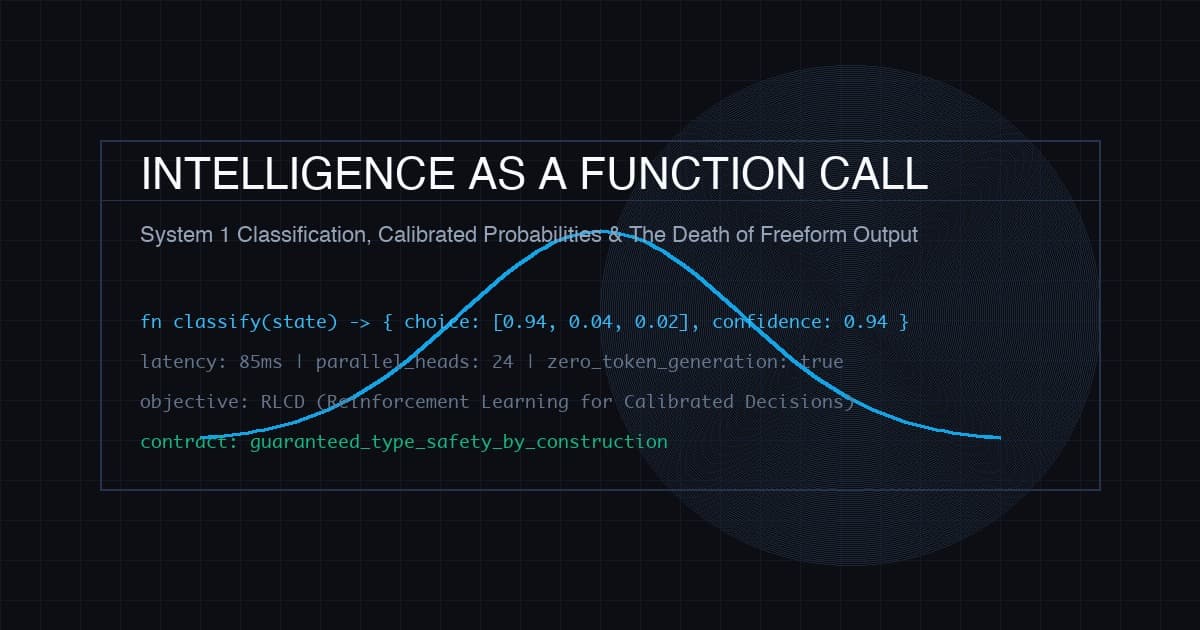
An architectural examination of TypeSafe's Jev, the shift from generative chat to calibrated classification, and why the future of AI in production software looks like typed function calls rather than prose.
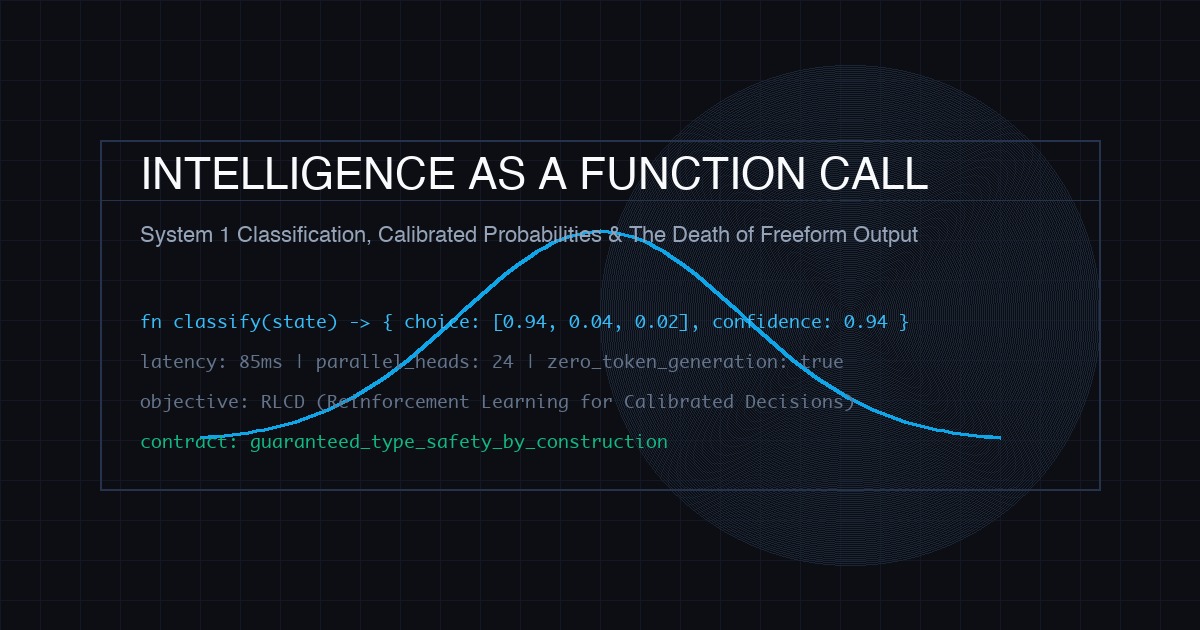
For three years, the industry conversation about artificial intelligence has been almost entirely consumed by generation. Write an essay, refactor a module, compose an email, hold a conversation.
Yet when you look under the hood of real production software, the overwhelming majority of day-to-day operations are doing something fundamentally different: deciding. Is this support ticket about billing? Is this financial transaction fraudulent? Does this candidate profile match the role? Should this request escalate to a human? Is this retrieved passage relevant to the user query?
In machine learning, that work has a foundational name. It is classification and regression, the oldest and least glamorous domain of the discipline, and it never actually went away. What happened instead is that engineering teams began tackling it with chat models, simply because chat interfaces and completion endpoints were what was available.
You write a prompt, you plead for JSON, you parse the response with a regex or a schema validator, and you hope the model does not decide to apologize halfway through the payload. Over the past few years, our industry built an entire generation of automated decision systems on top of a substrate designed specifically for conversational banter. We then spent thousands of engineering hours papering over that mismatch with retry loops, schema scrapers, and prompt engineering folklore.
TypeSafe AI, emerging out of stealth in September 2026 with $40 million from DCVC, is betting that this whole setup was a category error. Their flagship model, Jev, does not generate text at all.
What a System 1 Model Actually Is
The interface design of Jev is its entire statement. You supply two inputs: a state, which encapsulates whatever data the decision is about, and a set of questions, each with an explicitly declared answer space. In return, you receive one typed answer per question, accompanied by a probability distribution over the exact options you declared.
There are three question primitives:
- Choice: Selects one option from a declared set of mutually exclusive criteria.
- Score: Positions the input along a structured spectrum whose tiers you define.
- Noul: Computes the mathematical probability that a specific affirmative statement is true.
{
  "state": "Our API started returning 500 status codes twenty minutes ago, and order processing has stalled.",
  "questions": {
    "department": {
      "type": "choice",
      "criteria": {
        "billing": "Inquiries regarding invoices, credit cards, and subscriptions",
        "technical": "System outages, infrastructure errors, and bug reports",
        "sales": "Pricing questions and enterprise onboarding"
      }
    },
    "is_urgent": {
      "type": "noul",
      "instructions": "The message conveys active operational revenue loss or critical time pressure"
    },
    "frustration": {
      "type": "score",
      "criteria": ["Calm", "Frustrated but civil", "Extremely angry"]
    }
  }
}
No natural language prose is emitted. There are no markdown code fences to sanitize, no apologies if the system is uncertain, and zero probability that the model hallucinates an essay instead of returning a verdict. The response is a deterministic dictionary of probabilities.
The conceptual naming draws directly from Daniel Kahneman. System 1 represents fast, intuitive pattern matching; System 2 is slow, deliberate serial reasoning. There is a quiet historical irony here: when Yoshua Bengio popularized that framing for machine learning in 2019, he used System 1 to describe what deep neural networks already were, and System 2 as the reasoning frontier the field needed to conquer. TypeSafe has taken the label for the limitation and productized it as the solution.
Architectural Mechanics: How It Is Built
Three structural design choices drive the system:
1. A New Training Objective: RLCD
Post-training has historically followed two primary branches. Reinforcement Learning from Human Feedback (RLHF) optimized models to produce responses humans prefer, giving us conversational assistants. Reinforcement Learning with Verifiable Rewards (RLVR) optimized models to solve logic and code problems with provable answers, giving us modern reasoning systems.
TypeSafe introduces a third path: Reinforcement Learning for Calibrated Decisions (RLCD). Instead of optimizing for helpfulness or correctness on hard puzzles, RLCD optimizes for statistical calibration: probabilities that mean what they say. Over thousands of evaluated inputs, outcomes assigned a confidence score of 0.80 should occur almost exactly eighty percent of the time.
The founder profile makes this contrast particularly notable. Diogo Almeida co-invented RLHF. His argument today is that preference optimization trained modern models to sound deceptively confident, which becomes an operational liability when systems run unattended. Preference tuning also induces mode collapse, where an LLM narrows toward a favored rhetorical voice while silently suppressing valid alternatives. That is harmless in a conversational chat window, but catastrophic in an automated risk engine.
2. Single-Pass Parallel Sampling
Standard autoregressive language models generate tokens sequentially, each token conditioned on every preceding token. Jev evaluates and emits answers to every declared question simultaneously in a single forward pass.
This parallel architecture produces sub-second latencies: between 70 and 500 milliseconds end to end. More importantly, evaluating twenty questions concurrently costs almost the exact same latency as evaluating one.
3. A Mathematically Constrained Output Space
Because the candidate answers are declared upfront, the model distributes probability mass solely over the supplied options. TypeSafe notes that their zero-type-error benchmark is not an empirical measurement; it is an architectural guarantee by construction.
The economic model mirrors the compute footprint. Input tokens cost approximately four cents per million. Output tokens cost zero, because no token generation occurs in the traditional sense. As in my reflections on the evolution of natural language processing, whenever the fundamental unit of computation shifts, system economics change by orders of magnitude.
Where Calibrated Decision Layers Fit in Production
This is not a standalone platform. It is a specialized component designed to be dropped into standard software architectures wherever deterministic conditional logic becomes too brittle to maintain.
[ Inbound Request / Event ]
             │
             ▼
┌───────────────────────────────┐
│   Jev System 1 Decision Layer  │ ──> Latency: ~80ms | Cost: $0.04/M
│   (Parallel Calibrated Heads)  │
└───────────────────────────────┘
             │
      { Confidence >= 0.95 }
      ┌──────┴──────┐
      │             │
   (High)         (Low / Ambiguous)
      │             │
      ▼             ▼
[ Fast-Path ]   [ Human-in-the-Loop / Frontier LLM ]
Key high-leverage insertion points include:
- Triage and Request Routing: Directing tickets, leads, or incidents based on multi-dimensional criteria before waking heavy background jobs.
- Autonomous Guardrails: Inspecting inputs and outputs for prompt injections, data exfiltration, or toxic payloads at millisecond latency.
- Retrieval Reranking (RAG): Scoring retrieved passages for contextual relevance before injecting them into expensive context windows, as discussed in engineering for the agentic web.
- Tool-Call Verification: Evaluating an agent's proposed plan or tool payload against security policies prior to execution.
- High-Volume Feature Generation: Scoring massive historical datasets where deploying a frontier generative model is cost-prohibitive.
In published benchmarks, reranking legal search candidates using this method lifted top-1 retrieval accuracy from five percent to eighteen percent. Similarly, classifying regulatory filings across seventy-five sector categories used the model's self-reported confidence to dynamically select the granularity of the classification: emitting the specific sub-industry when confidence exceeded 0.90, and safely falling back to the broader division when confidence dipped. That pattern is impossible when working with uncalibrated generative models.
The Accuracy Paradox in Automated Systems
The most common misconception about decision models is focusing solely on raw headline accuracy. In autonomous production systems, raw accuracy is secondary. What truly dictates business value is whether the model is wrong in a detectable way.
Consider two hypothetical systems:
- Model A: 98% accurate on a benchmark, but its confidence scores are uncalibrated. It is equally confident when it is right as when it makes a catastrophic error in its 2% failure mode.
- Model B: 95% accurate, but its probability outputs are strictly calibrated. It flags nearly all of its 5% failure cases with confidence scores below 0.70.
Model A wins every marketing leaderboard. Yet Model B automates vastly more production work.
With Model B, an engineering team can set an operational cutoff: automatically process the 92% of traffic that falls above the 0.85 confidence threshold, and route the remaining 8% to human review. Model A cannot be trusted unattended; because its errors are indistinguishable from its successes, a human must review everything, or the company must accept silent failures.
If an automated system can execute a task accurately 95% of the time, but cannot detect when it enters the remaining 5%, it cannot be safely automated at all.
Verbalized self-assessment from generative chat models does not solve this. When an LLM outputs "I am 95% certain," that phrase is simply a sequence of tokens shaped by conversational training, not an introspection into internal logit distributions. When tested against ground truth, verbalized confidence correlates weakly with empirical correctness.
Limitations and System Boundaries
No architecture is without trade-offs. The constraints of a pure classification engine require clear engineering boundaries:
1. Arithmetic, Dates, and Sequential Logic Belong in Code
Classification models struggle with exact counting, mathematical arithmetic, and temporal reasoning. A date string is parsed as textual tokens rather than an ordered chronological scalar.
The mitigation is straightforward: extract with the model, compute with code.
Let the model classify the extracted strings or components into closed categories, and handle date math, duration windows, thresholding, and arithmetic in Python or TypeScript. Software does deterministic math perfectly and for free.
2. Adversarial Text Ingestion
When an incoming text payload is written adversarially to argue for its own legitimacy, a classification head without multi-step reasoning can be influenced. As I have examined in generative AI and threat detection, adversarial actors continuously evolve payloads to bypass static classifiers. Testing adversarial edge cases remains mandatory before deploying any model as an external security boundary.
3. Decomposing Complexity Into Atomic Signals
Instead of asking a single broad question such as "Is this message phishing?", effective deployment requires decomposing the decision into six or seven atomic queries:
- Does the message claim immediate account suspension?
- Does the sender display name mismatch the sending domain?
- Does the text ask for credential input?
- Is an external shortened link present?
Because Jev processes questions in parallel, querying seven specific signals incurs zero latency penalty compared to querying one. This allows engineering teams to maintain inspectable weights for each signal in software rather than relying on an opaque, unweighted generative summary. This avoids the vague prompt-tuning loops described in the agentic AI echo chamber.
Strategic Verdict: The Commoditization of Decision Layers
Is this the "ChatGPT moment" for classification? Probably not, and that comparison misunderstands the market.
ChatGPT was a consumer interface breakthrough. The underlying capabilities had existed in research labs for months, but placing a simple chat box on top ignited viral adoption. A calibrated decision engine has no consumer interface; its audience consists of backend engineers, data scientists, and infrastructure architects. Its growth trajectory will resemble Stripe or Twilio rather than a viral consumer product.
The deeper strategic question is whether specialized classification models represent a defensible company or a feature of the broader infrastructure stack. Constrained decoding and parallel heads are established engineering techniques that frontier labs can implement. The primary defensible asset is the RLCD training process itself: whether reinforcement learning for calibration produces decision distributions that consistently outperform logit readouts from scaled foundation models.
Regardless of which vendor dominates the category, the conceptual shift is permanent. The industry spent three years optimizing conversational fluency for the small fraction of AI workflows that interface directly with humans. As autonomous systems expand, the majority of intelligence will run quietly inside software pipelines, operating not as conversational partners, but as fast, reliable, typed function calls.