Why Every Company Needs a Generative AI (GAI) Squad, And How to Build One

In the fast-paced era of technological advancement, the emergence of Generative AI (GAI) isn't merely evolutionary, it's revolutionary. Companies at the forefront are already…
In the fast-paced era of technological advancement, the emergence of Generative AI (GAI) isn't merely evolutionary, it's revolutionary. Companies at the forefront are already harnessing the power of GAI to redefine their operations, product development, and customer experiences. Those who fail to adapt risk becoming obsolete. Now is the optimal moment to integrate a dedicated Generative AI Squad into your organizational framework.
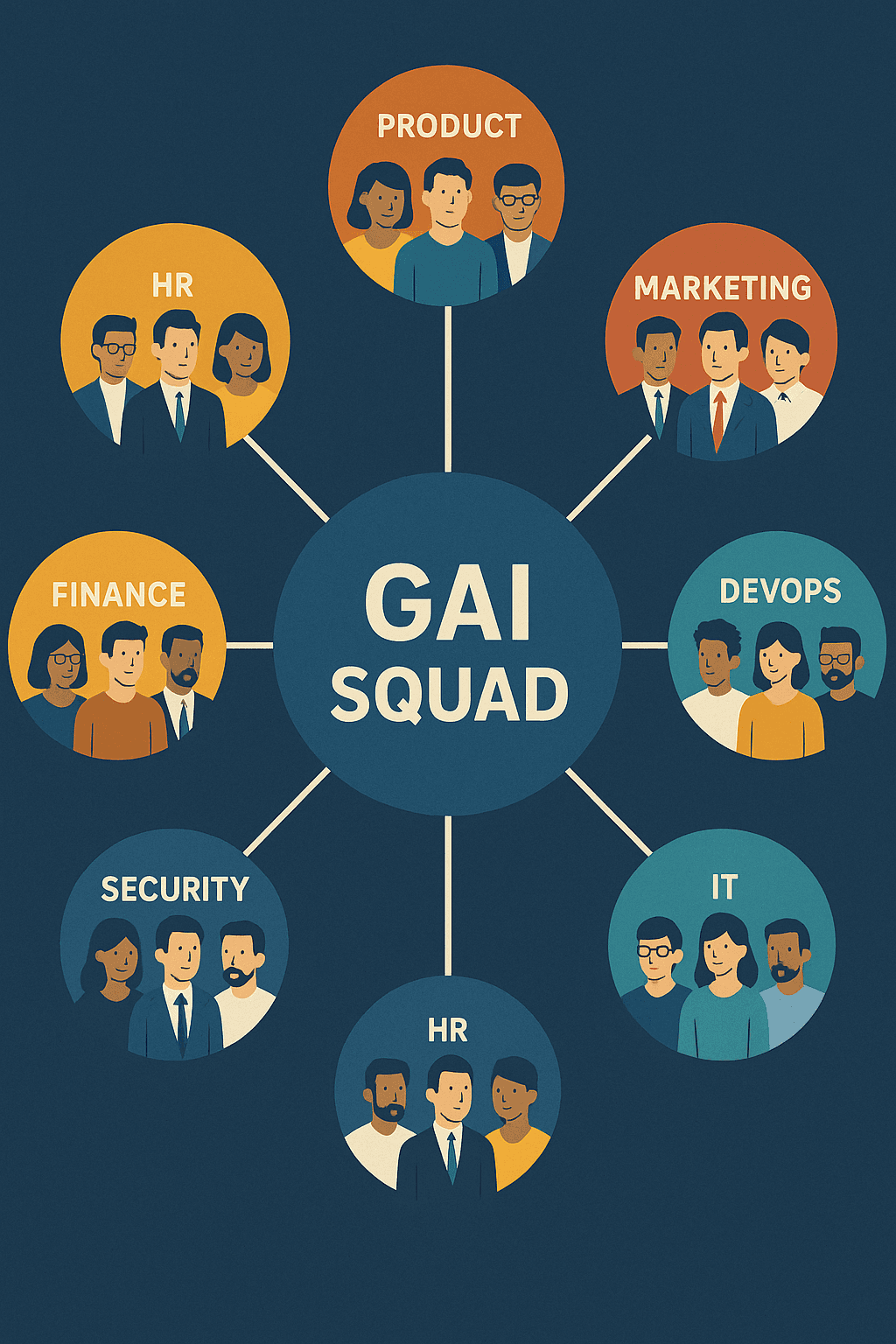
Image created by chatGPT-4o
Why Is Now the Imperative Moment to Deploy Generative AI Squads?
Now is the imperative moment because foundational AI models, specialized inference compute, and enterprise data have converged into practical business utility. Organizations establishing dedicated Generative AI squads today capture asymmetric operational leverage, while competitors relying on fragmented, ad-hoc experimentation risk rapid technological obsolescence.
The current convergence of data availability, computational power, and advanced generative models has made it viable, and necessary, to embed GAI into organizational DNA. Companies adopting this today will experience dramatic improvements in operational efficiency, product innovation, and competitive positioning.
Early adopters will:
- Gain significant competitive advantage.
- Establish themselves as innovation leaders.
- Rapidly realize measurable ROI through enhanced efficiency and automation.
How Should Executive Leadership Structure the Enterprise for Generative AI?
Structuring an enterprise for generative AI requires executive stewardship, such as a VP of Generative AI or Head of AI Strategy. This dedicated leader bridges executive business objectives with operational squads, establishing measurable KPIs, governing security guardrails, and aligning technological adoption directly with company-wide business outcomes.
Integrating Generative AI requires more than technology adoption; it demands an organizational shift. Forward-thinking companies are creating executive roles such as a VP of Generative AI, tasked with championing GAI strategy across the entire organization. This executive not only oversees the formation and operation of GAI squads but also ensures alignment with broader business objectives and measurable KPIs.
How Do Cross-Functional GAI Squads Operate Across Core Business Units?
Cross-functional GAI squads embed dedicated AI engineers into core operational units: operations, product development, sales, IT, and cybersecurity. Operating with explicit Objectives and Key Results (OKRs), each squad automates repetitive workflows, accelerates feature iteration, and extracts real-time telemetry from enterprise business data.
Generative AI Squads should operate cross-functionally, embedding deep AI capabilities into diverse aspects of the business. Here's how:
- Operations & Automation: GAI squads drive process automation, significantly reducing manpower and improving operational velocity.
- Market Research & Product Development: GAI can rapidly generate insights, simulate market scenarios, and streamline product iteration.
- Marketing & Sales: AI-driven content creation, hyper-personalization, and predictive analytics enhance funnel conversions and customer engagement.
- DevOps & IT: Automation of routine tasks, real-time monitoring, and predictive maintenance.
- Security & QA: Generative AI aids in proactively identifying vulnerabilities, enhancing testing coverage, and streamlining compliance.
- HR & Finance: Automating administrative tasks, facilitating talent acquisition, predictive analytics for financial forecasting, and risk assessment.
Each squad operates with clearly defined OKRs (Objectives and Key Results), enabling easy tracking of performance and ROI metrics such as automation levels, reduction in manpower, improvements in product velocity, enhanced customer satisfaction, and optimized funnel conversion rates.
How Can Organizations Bridge the Critical Generative AI Engineering Talent Gap?
Bridging the AI talent gap requires combining targeted hiring with aggressive internal upskilling and continuous technical training. Forward-thinking organizations cultivate internal champions, sponsor specialized engineering bootcamps, and build learning environments that empower existing software developers to master agentic and generative toolchains.
A significant challenge organizations face today is the acute shortage of skilled Generative AI engineers. HR teams must employ creative strategies, including internal upskilling programs, bootcamps, and partnerships with educational institutions, to build this critical talent pool. Companies must act proactively to nurture talent capable of understanding and leveraging the full potential of GAI.
What Role Must the Board of Directors Play in Governing AI Strategy?
The Board of Directors must govern generative AI adoption as a top-level fiduciary and risk management imperative. Boards should establish dedicated AI oversight committees, track strategic capability benchmarks, and ensure enterprise governance frameworks balance aggressive innovation against security and compliance risks.
The strategic importance of Generative AI means it must be on the agenda of every board meeting. Boards should immediately establish and monitor GAI-specific KPIs to guide organizational focus and investments. The oversight and strategic input from directors will be pivotal in successfully integrating GAI throughout the enterprise.
How Do Enterprises Accurately Measure the ROI of Generative AI Initiatives?
Enterprises measure generative AI success through concrete operational metrics: human labor hours displaced, development velocity acceleration, customer satisfaction lift, and margin improvements. Rigorous accounting tracks real workflow cost savings against model inference expenditures to verify net business value.
Implementing GAI squads allows for highly measurable outcomes. Companies can quantify the value generated through:
- Increased automation and reduced labor costs.
- Enhanced customer experience metrics.
- Accelerated development and operational timelines.
- Improved decision-making capabilities and predictive accuracy.
What Is the Strategic Path Forward for Enterprise AI Leadership?
The strategic path forward requires committing to structured organizational adaptation rather than isolated software pilots. Embedding disciplined Generative AI squads into operational architecture establishes an enduring competitive advantage that compounds as autonomous technologies mature.
In the transformative landscape of today’s business world, generative AI is no longer optional, it's essential. Companies that swiftly embed GAI squads into their strategic framework will not only lead in innovation but secure sustainable, long-term competitive advantage.
Are you ready to reshape your organization’s future with Generative AI?
#GenAI #GAI #AI #GENERATIVEAI #GAISQUAD