The Death of Security by Obscurity: Why Fraud and Cyber Defense Must Go Long-Tail

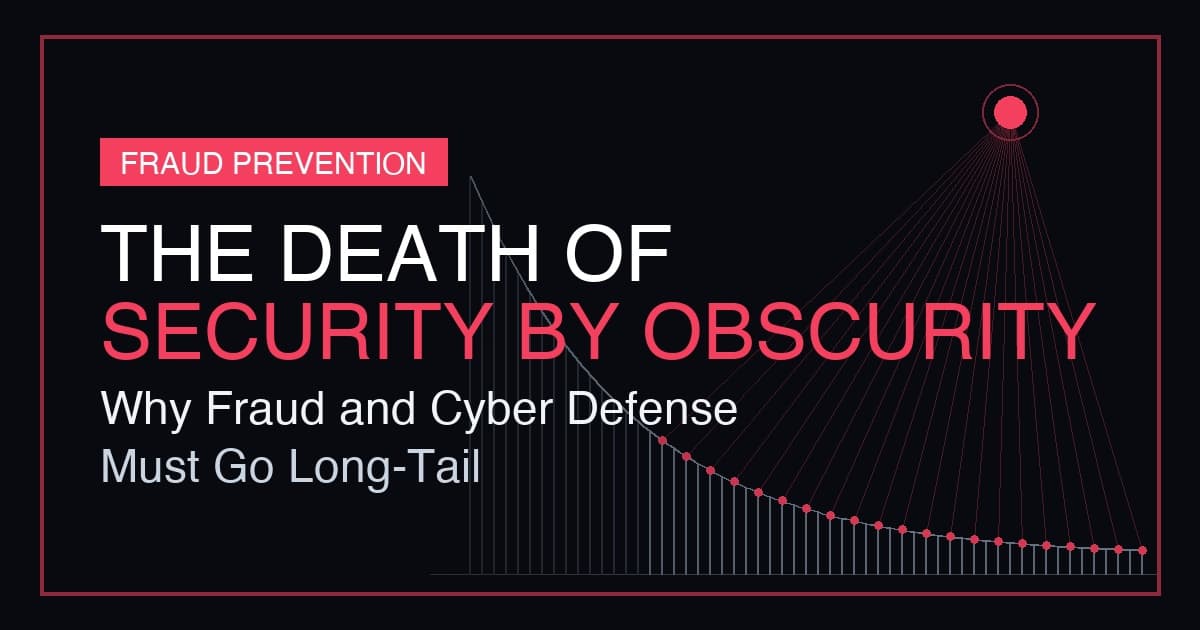
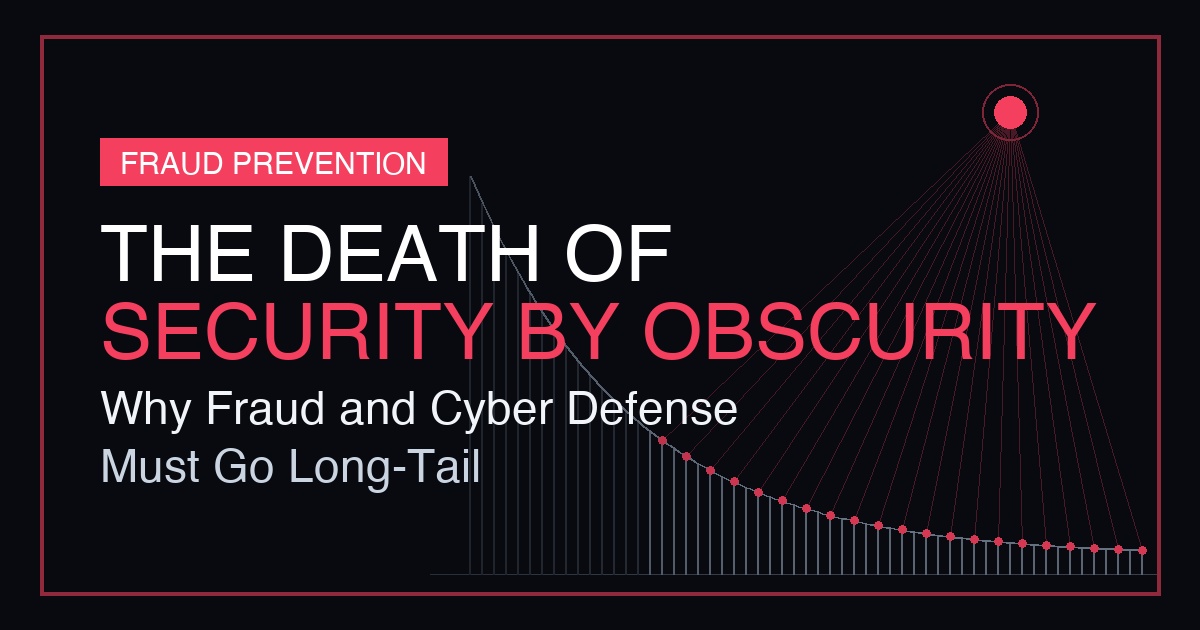
For decades, niche websites, micro-apps, and ordinary consumers were protected by economic obscurity: attacking them for small payouts cost more than the loot was worth. As AI drives the cost of both custom software and customizable attacks toward zero, fraud prevention and cybersecurity must go long-tail too.
- The Collapse of Economic Obscurity: Until recently, niche websites, small business portals, and indie applications enjoyed an invisible shield. They were not free of vulnerabilities; they were simply too small to justify the human labor required to study and exploit them. When autonomous attack cost drops near zero, even ten-dollar values get harvested at scale.
- The Twin Long-Tail Explosions: Two forces are colliding on the internet: AI coding tools are creating an explosion of niche, long-tail software built without security teams, while AI offensive agents make bespoke, customizable fraud and cyber attacks effortless to scale across millions of unique targets.
- Bringing Fraud and Cyber Defense to the Consumer and Micro-Builder: Consumer security stopped at antivirus, password managers, and credit monitoring. The real fraud-prevention stack, from device intelligence to behavioral risk scoring, was only ever sold to large enterprises, never to the individual consumer or the long-tail application. Defense must now unbundle from six-figure enterprise contracts into ambient, consumer-grade and micro-app protection.
For the first thirty years of the commercial web, millions of small websites and niche applications relied on an unspoken security architecture. It was not zero-trust networking, formal verification, or hardware-backed encryption.
It was the fact that nobody important knew they existed, and nobody skilled could afford to care.
If you built a custom booking portal for a local ceramics studio, a niche SaaS tool for two hundred independent freight brokers, or a community forum for vintage watch collectors, your application probably had broken object-level authorization, weak rate limits, and zero behavioral fraud detection. Yet years went by without a breach or a coordinated fraud ring draining your accounts.
You were protected by economic obscurity.
In a world where crafting a custom exploit or learning the quirks of a niche checkout flow required hours of a human attacker's time, small targets had negative return on investment. Why would a skilled syndicate spend three days reverse-engineering a boutique web app to steal four hundred dollars when they could spend that same effort attacking a major bank or a global e-commerce marketplace?
That era is over.
Two structural shifts are colliding simultaneously: software itself is becoming vastly more affordable and long-tail, while cyber and fraud attacks are becoming customizable at near-zero marginal cost. When both the software and the attack go long-tail, fraud prevention and cybersecurity have no choice but to go long-tail as well.
1. Why Did Anonymity Protect Niche Websites Until Yesterday?
In the human-operated threat era, every bespoke attack carried a minimum labor floor. Because studying an unfamiliar website, writing a custom script, or staging a tailored social-engineering pretext cost hundreds of dollars in attacker time, any target whose harvestable value sat below that floor remained safe by default. AI removes that floor completely.
To understand how profoundly the threat model of the internet is changing, we have to look at the unit economics of a bad actor.
Historically, attackers had only two modes of operation:
- Mass Commodity Broadcasts: An attacker wrote a single rigid script that scanned the internet for a known CVE in a popular WordPress plugin, or sent ten million identical phishing emails pretending to be a national postal service. If your niche app ran custom code and did not use that specific WordPress plugin, the automated scanner bounced right off you.
- Bespoke Human Targeting: If an application had a custom workflow, a unique API structure, or a specialized business logic layer, exploiting it required a human operator to sit down, inspect the network tab, understand how credits or payouts worked, and write a dedicated attack script.
That division created a massive safe harbor in the middle of the internet.
As long as your application was custom enough to dodge generic WordPress bots, yet small enough to stay below the radar of human red-teamers and professional fraud rings, you lived in a blind spot. Anonymity functioned as a firewall.
Security by Economic Obscurity vs. Zero-Cost Long-Tail Harvesting
The Old Regime (Human Attacker Floor)
- High Customization CostAdapting an attack to a unique app workflow requires hours of human recon
- Whale-Only ROI FilterAttackers ignore niche sites and small balances because labor exceeds the loot
- Safety Through AnonymityCustom micro-apps survive for years without dedicated fraud or cyber controls
False comfort: niche builders mistake low attacker ROI for actual security
The New Regime (Autonomous Long-Tail Harvesting)
- Zero-Cost AdaptationAI agents read arbitrary DOMs, APIs, and business logic on the fly for fractions of a cent
- Micro-Value HarvestingEven $5 API credits, local gift cards, and niche user databases become profitable
- Universal ReachEvery obscure endpoint and personal workflow receives bespoke adversarial pressure
No hiding place: defense must scale down to the smallest app and individual user
In my essay on the affordability threshold and how cost compression multiplies behavior, I examined how dropping the price of an action by two orders of magnitude causes its frequency to explode.
Apply that exact math to target selection. When an autonomous agent can visit an obscure web application it has never seen before, parse its registration flow, infer its business logic, test for parameter tampering, and execute a customized fraud loop for half a cent of compute, the minimum profitable harvest drops from five thousand dollars to fifty cents.
When the attack costs nothing, it reaches everywhere. Nothing is too small to harvest.
2. How Are Long-Tail Software and Customizable Attacks Colliding?
We are witnessing a simultaneous explosion on both sides of the ledger. AI coding tools allow non-engineers and solo builders to publish millions of niche, long-tail websites and micro-apps, while AI offensive agents make tailored fraud and cyber attacks cheap to scale. The attack surface is fragmenting at the exact moment bespoke exploitation becomes free.
Look at the two curves that are rising at the exact same time.
The first curve is the long-tail software explosion. For decades, high development costs concentrated the internet around a few hundred mega-platforms. Small communities and micro-businesses rented space inside Facebook groups, Shopify templates, or spreadsheets because building a standalone application was too expensive.
Today, natural-language coding agents let a solo founder, a neighborhood school, a freelance consultant, or a hobbyist spin up a full-stack web application with authentication, database storage, payment webhooks, and LLM integrations in a single weekend. Over the next few years, tens of millions of hyper-niche applications are likely to go live on the open web.
Who is building this long-tail software? Domain experts, creators, small business owners, and solo developers who do not have a Chief Information Security Officer, a fraud operations team, or a fifty-thousand-dollar enterprise WAF contract.
Now look at the second curve: affordable, customizable attacks.
In the past, an automated bot failed the moment a website changed a form field name or introduced an unconventional multi-step checkout flow. Today, an autonomous attack agent does not rely on brittle CSS selectors. It reads the page semantically just like a human user, understands what the application offers, and adapts its strategy on the spot:
- Micro-SaaS Resource & Credit Draining: Thousands of indie AI and SaaS apps offer a free tier backed by the founder's own OpenAI, Anthropic, Twilio, or Stripe account. Autonomous fraud agents discover a new indie app within hours of deployment, navigate its custom onboarding flow, and drain its upstream API credits or abuse its trial compute to launder tasks.
- Long-Tail Business Logic Abuse: A local sports club launches a custom booking app with a referral credit system. An agent understands the referral rules from the UI text, generates synthetic identities that pass basic email checks, and harvests the payout or gift-card balance overnight.
- Automated Boutique Spear-Phishing: An agent scrapes a niche B2B directory, reads the exact terminology and client list of a four-person architecture firm, and sends a hyper-specific invoice update or contract amendment that looks indistinguishable from their daily project correspondence.
When millions of newly minted long-tail applications meet autonomous agents that can customize an attack for pennies, the middle of the internet turns into an open harvesting ground.
3. Why Did Fraud Prevention Never Target the Consumer Until Now?
Apart from antivirus, password managers, and credit monitoring, the cybersecurity and fraud prevention industry built its product stack for large enterprises. Consumers and micro-businesses were left to fend for themselves because bespoke fraud rarely targeted individuals directly. In an era of cheap, personalized AI deception, the individual consumer becomes a primary front-line target.
Think about the history of the security industry over the last thirty years.
Aside from antivirus suites, password managers, and credit monitoring, when did the cybersecurity or fraud prevention industry ever build serious tooling for the individual consumer?
Almost never.
Fraud prevention engines, device fingerprinting, behavioral biometrics, identity graph correlation, velocity rules, payment risk scoring, and synthetic media detection were built for big institutions. Banks bought fraud engines to protect the bank. E-commerce giants bought fraud engines to protect the marketplace. Social networks bought trust-and-safety pipelines to protect the platform.
The ordinary consumer and the five-person business were never the customer of fraud prevention. They were merely data points inside an enterprise's risk model.
Why did that arrangement hold together for so long? Because targeting an individual consumer or a tiny business with a tailored, multi-stage fraud operation was economically irrational for criminals. A human con artist could not afford to spend four days researching your family's schedule, imitating a relative on the phone, and spoofing a local contractor's billing portal just to steal three hundred dollars from your checking account.
Now that AI compresses the cost of personalized deception to near zero, the consumer and the micro-business are under direct, customized siege:
- Hyper-Personalized Consumer Fraud: Consumers no longer face broken-English mass spam. They face real-time voice-cloned calls referencing a real trip they took last week, synthetic support agents that guide them through authorizing an instant bank transfer, and tailored marketplace scams built around their public social footprint.
- The Vulnerable Solo Builder: A creator or solo developer launching a niche web app has the exact same exposure to credential stuffing, payment card testing (carding), synthetic account creation, and prompt-injection exfiltration as a Fortune 500 company, without a single dollar of enterprise security budget.
- Personal Agent Hijacking: As consumers begin running their own personal AI agents to manage calendars, emails, shopping, and travel bookings, attackers will target the consumer's agent directly through indirect prompt injections hidden in everyday web pages and messages.
4. What Does Long-Tail Fraud and Cyber Defense Look Like?
If software creation and adversarial attacks have both gone long-tail, defense cannot remain locked behind enterprise sales calls and six-figure annual contracts. Fraud prevention and cybersecurity must become ambient, zero-configuration primitives embedded directly into the tools used by solo builders and everyday consumers.
You cannot ask a solo developer earning eight hundred dollars a month from a niche web app to hire a security analyst or sign an enterprise fraud-prevention contract. And you cannot ask an ordinary consumer to run a Security Operations Center in their living room.
For fraud prevention and cyber protection to go long-tail, three architectural shifts must happen across the industry:
- Embedded, Zero-Config Fraud and Cyber Primitives for Micro-Apps: Just as Stripe turned complex merchant banking into seven lines of code and Let's Encrypt made TLS certificates free and automatic for the smallest blog, fraud and cyber defense must ship inside the default application template. When an indie builder deploys a Next.js or Python app with an AI coding agent, behavioral bot detection, synthetic-account blocking, API credit circuit-breakers, and keyless credential brokering must be active out of the box for fractions of a cent per request.
- Consumer-Side Fraud Co-Pilots and Identity Verification: Just as consumers needed antivirus when executable malware went mainstream in the 1990s, consumers now need personal fraud-and-cyber guardians across their phone, browser, and inbox. When an incoming call, invoice, or payment request arrives, the consumer's own device should verify cryptographic sender provenance, detect synthetic voice or video manipulation in real time, and flag behavioral anomalies before money or credentials leave their hands.
- Autonomous Defensive Agents for the Long Tail: In my writing on why ensembles outperform single models in fraud prevention and why authentication must evolve for autonomous agents, I emphasized that defense requires layered, deterministic verification. Because long-tail builders cannot staff a 24/7 security team, they will rely on autonomous defensive harnesses that continuously red-team their niche app, patch exposed routes, and throttle abusive actors automatically.
The Verdict
Anonymity is no longer a security strategy.
For thirty years, being small, niche, or ordinary was enough to keep you out of the crosshairs of sophisticated fraud and tailored cyber attacks. Attackers had to ration their creativity for targets that could pay for their time.
AI has erased that rationing. At the exact moment AI empowers millions of people to build long-tail software, websites, and micro-businesses, it also empowers bad actors to customize fraud and cyber attacks for nothing and send them everywhere.
The next great frontier in security is not selling another million-dollar dashboard to the Fortune 500. It is bringing real fraud prevention and cyber protection down to the long tail: to the solo builder, the niche application, and the everyday consumer who just became profitable to attack.