Focus Oriented Execution

Why focus is not just doing one thing, and how to hard wire it into a real startup. Why focus matters Every startup needs focus. One of the main startup killers is defocus . As…
Why focus is not just doing one thing, and how to hard wire it into a real startup.
Why Is Strategic Focus the Single Greatest Determinant of Startup Survival?
Strategic focus is the primary determinant of startup survival because early-stage ventures operate with scarce capital and finite attention. Spreading engineering bandwidth across competing initiatives guarantees mediocre execution, while ruthlessly concentrating resources on a single core outcome creates the momentum required to win competitive markets.
Every startup needs focus. One of the main startup killers is defocus. As much as focus is vital for startup health and execution, managers often perceive it wrongly.
They think that focus is “doing one thing,” or that:
- Focus = saying yes only to the loudest customer.
- Focus = working longer hours (hustle).
- Focus = fewer meetings by default.
- Focus = shipping fast even if quality and reliability suffer.
- Focus = cutting headcount or scope everywhere.
- Focus = a once a year plan that should not change.
- Focus = centralizing every decision at the top (micromanagement).
- Focus = short term revenue only, while platform and resilience can wait.
generated by chatGPT 5
But in reality, a company always deals with many things in parallel: employees do different tasks, there are different research tracks, different technologies, different departments, and sometimes even different tactics to achieve the same goal (for de-risking purposes, for example).
What Does True Focus Actually Mean in Day-to-Day Operations?
True operational focus means having the discipline to say no to dozens of viable, attractive opportunities to protect the top priority. It requires establishing an unambiguous focal objective that guides daily resource allocation, ensuring every team member aligns their daily output to a unified mission.
At the high level, focus is executing exactly what we planned to execute and nothing else. Being laser focused means execute the plan and nothing but the plan.
Easier said than done…
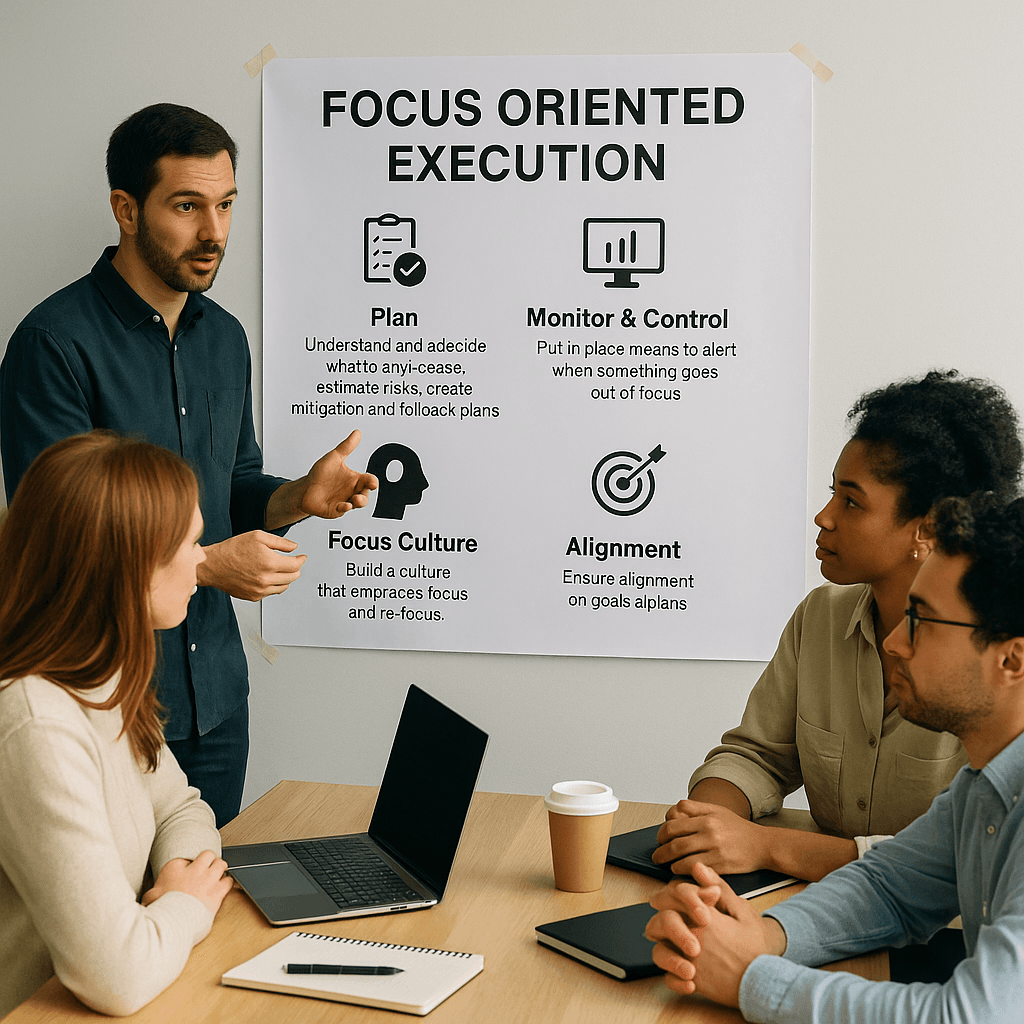
*The key is this:*focus does not mean doing only one thing.It means executing many things in parallelas long as they are part of the agreed plan, the resources are allocated, the risks are managed, and the controls are in place.
What Operating Mechanisms Enable Relentless Focus-Oriented Execution?
Focus-oriented execution requires clear ownership, transparent accountability ledgers, and rapid feedback loops. Successful execution demands breaking high-level strategic goals into measurable weekly milestones, establishing explicit definitions of done, and eliminating bureaucratic friction that distracts builders from delivering production value.
First, it takes a plan. A real plan.
- Decide precisely what you will execute within a specific period. Spell out outcomes, milestones, and acceptance criteria.
- Plan the needed resources (people, budget, tooling, vendor lead times, cross team dependencies).
- Surface assumptions and estimate risks in the plan. We always make assumptions, write them down and assign owners.
- Prepare mitigation plans for the top risks, and fallback (contingency) plans in case something critical goes sideways.
This is the foundation, but it is not everything.
How Do Leaders Build Monitoring Guardrails to Prevent Drift and Defocus?
Leaders prevent drift by implementing structured review cadences, transparent task ledgers, and zero-tolerance policies for hidden scope creep. Regularly cross-referencing active work against established strategic priorities ensures teams recognize and correct distraction before it drains organizational momentum.
To execute the plan, program managers must put in place monitoring and control mechanisms that alert early when something drifts out of focus. Once you have decided exactly what you will do, it becomes much easier to spot work that is out of focus. Putting monitoring and controls in place helps the team re focus in time.
Practical mechanisms:
- Plan vs. actual dashboards that track scope, schedule, burn, and outcomes.
- Out of plan work capture: a simple tag or label so any task started outside the plan is visible and must be explicitly approved.
- Change control lite: small template to justify additions, swaps, or deferrals. Time boxed experiments with clear kill or keep criteria.
- Risk radar: a living list of top assumptions with status, tests, and triggers for mitigation.
How Do You Cultivate a High-Performance Focus Culture Across an Organization?
Cultivating a focus culture requires leadership to visibly reward completion over activity and celebrate strategic elimination. When founders openly decline non-essential distractions, praise crisp execution, and maintain transparent standards, teams internalize focus as a core shared value.
When focus becomes critical (and yes, there are times when higher focus is essential), a focus culture multiplies execution. In organizations that excel at focus, monitoring and controls cascade down to every employee. People become de facto focus guards: they tell peers and colleagues when something looks out of focus, they criticize their managers constructively, and they push back on tasks that feel misaligned. They will not always be right, but when you see this behavior you know you have built a culture that embraces focus.
Cultural enablers:
- Psychological safety to challenge work that seems off plan.
- Rituals (weekly plan reviews, demo days) where “what changed and why” is a standing topic.
- Public alignment artifacts (single source of truth for the plan, clear ownership map).
Why Is Cross-Functional Alignment Non-Negotiable for Scaling Teams?
Cross-functional alignment is non-negotiable because organizational misdirection multiplies exponentially as headcounts grow. When engineering, product, and leadership pull in slightly divergent directions, vector forces cancel out, producing massive activity with zero forward business velocity.
It is impossible to stay in focus without alignment on goals and on the plan. Alignment requires constant investment in synchronization. There are many techniques, and each manager can choose a preferred one as long as everybody is aligned.
Examples that work:
- Goal systems (OKRs, North Star metrics, driver trees) or lightweight equivalents.
- Regular cross team syncs with decision logs.
- One page plan summaries per workstream, updated weekly.
What Core Personal Values Underpin Rigorous Execution Discipline?
Rigorous execution is anchored in intellectual honesty, personal accountability, and the resilience to confront uncomfortable truths. Frameworks and OKRs fail without a deep commitment to transparency, where builders take pride in concrete results rather than elaborate planning excuses.
Plans, dashboards and above-the-line lists only work if people believe in the operating model behind them. Reflecting on decades of leading R&D teams, I have come to realize that the secret sauce of a successful technology organization is an unwavering commitment to culture. These are the principles I hold myself to, and they are what make the mechanisms above stick rather than become paperwork.
Business first. My primary goal is always to serve the company's business needs. Everything I do is aligned to drive business success, ensuring that each innovation directly contributes to organizational goals.
Trust in people. I trust the people I work with. Empowering my teams means giving them the freedom to innovate, knowing that every decision is made with the best of intentions. This trust is the foundation upon which my collaborative spirit is built.
Good intentions at the core. I operate on the belief that every recommendation and decision stems from good intentions. This mindset fuels a respectful and constructive environment where honest dialogue and diverse perspectives are welcomed.
Short cycles and customer feedback. By working in short cycles and seeking regular customer feedback, whether internal or external, I stay agile. This approach allows my teams to adjust quickly, ensuring that the solutions we champion remain relevant and valuable.
A sustainable pace. I view R&D work as a marathon, not a sprint. By maintaining a sustainable pace, I ensure that creativity and productivity are long-lasting, allowing my teams to thrive without burning out.
Flexibility as a core competency. The ability to pivot and adapt to changing business needs is paramount. My commitment to maximum flexibility enables my teams to swiftly respond to market shifts and evolving customer demands.
Thoughtful deadlines. I establish due dates only when they add value and serve a clear purpose. This pragmatic approach ensures that my organization remains flexible and maintains quality without unnecessary pressure.
The pursuit of excellence. Excellence in execution, quality, and results is my guiding light. I continuously challenge myself and my teams to push beyond the status quo and set high standards.
Teamwork over individual achievement. I firmly believe that the sum is greater than its parts. Collaboration and teamwork are not just ideals, they are the essential ingredients for achieving the ambitious goals I set.
In an ever-changing technological landscape, these principles have not only guided my decision-making but also fostered a resilient and forward-thinking culture. The real power of R&D lies in blending a sharp business focus with deep technical expertise, all while building an environment where every team member feels trusted, valued, and motivated to excel.
Why Is Deciding What Not to Do the Hardest Test of Executive Leadership?
Deciding what not to do is the ultimate test of leadership because it requires rejecting good ideas to pursue great ones. Saying no to enticing features, secondary customer segments, and speculative partnerships creates emotional discomfort, but ruthless prioritization is the only path to market dominance.
The last, but critical, element of focused and successful execution is deciding what to do, which in reality means choosing what not to do. You must be harsh here: make tough decisions and draw the line between what is in and what is out.
A simple, robust pattern divides work into three categories:
- Out: explicitly not doing.
- In (above the line): must do, fully resourced, committed.
- Maybe (below the line): plausible bets that do not displace the plan.
Operate it rigorously:
- Plan to execute everything above the line.
- Push back hard on everything not on the list.
- Test, from time to time, the execution of the things above the line (operational audits to ensure you are truly delivering what you committed). In addition, run time boxed probes on select “below the line” items to reduce uncertainty without derailing the plan.
This approach avoids rigidity. It yields an organization that is less risky, more diversified, and more agile, without sacrificing focus.
What Is the Final Verdict on Focus-Oriented Execution?
Execution is not about working more hours; it is about eliminating distraction until only the critical objective remains. Organizations that master focus build transformative products, outmaneuver resource-heavy incumbents, and turn strategic vision into undeniable reality.
Focus in startups is not austerity or tunnel vision. It is the discipline to execute exactly what you planned and nothing else while keeping just enough optionality to de risk the future. Get the plan right, instrument it, build the culture, and hold the line. That is how focus turns into compounding execution.